Nessa Carey
ukudala (Zulu) — to make, to create. The ear also hears kudala: long ago.
Five plays, one life, one unfinished portrait.
The five plays
ukuzwa — to hear, to feel, to sense
Five acts · cast of five · about 90 minutes
A memory play on a split stage: Durban in 1980 and Perth a decade later. Aisha learns to tell her own story.
umoya — the air, the wind, the breath, the spirit
Two acts with an interval · about 100–110 minutes
Eight children in a shared yard on the Cape Flats, and a mother who reads tea leaves. Funny, tender, cruel and alive.
izikhala — the gaps, the spaces between
Four acts
Inheritance: how trauma and control pass down the generations, through love and the wish to protect.
ukusesha — to look for, to seek
Five acts with a Chorus
Maggie is carried from apartheid South Africa to Spain, Wales, Swaziland and Australia, until she frees herself.
umthwalo — a load, a burden, the luggage one carries
Two acts · eighteen scenes
1976. Claudia, nine, at a boarding school in the Natal cane fields. Her letters are spoken to her mother: the audience.
The mosaic
Nessa’s outline, traced from a photograph and laid in tiles. Every scene adds a thread of tiles in earthy browns drawn from her heritage, one colour family to each play. Five plays have filled almost all of the figure. Each new work fills a little of what remains, so it keeps growing but can never be finished.
The works form, length, state
Pink Shoes · Picking Up · Georgia’s Lot · Back to Before · Obsession · The Pastor’s House
Six stories of girls and women, from a crowded house on the hill to a boarding school in the cane fields and a grand house above Mbabane. Each meets what the world hands her and finds her own way through.
Poems written as they were lived, with no sugar-coating: for her daughter, of a South African childhood, and of fear, home and colour.
Dalaring what’s still being made up
dalaring (Kaaps, from dala, to make) — making it up. Which is the method: these are lives fictionalised, not transcribed.
The playwright
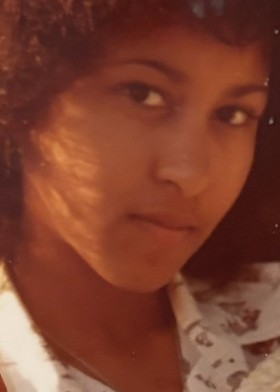
Nessa as a teenager, planning to swim home, across the Indian Ocean, from Fremantle to Durban.
The caption to the second photograph
Her subject is southern Africa’s Coloured community under apartheid, and the lives that carried on afterwards, here — plays, short stories, poems and a novel in progress, each of them arguing with a system that decided in advance what she was allowed to say.
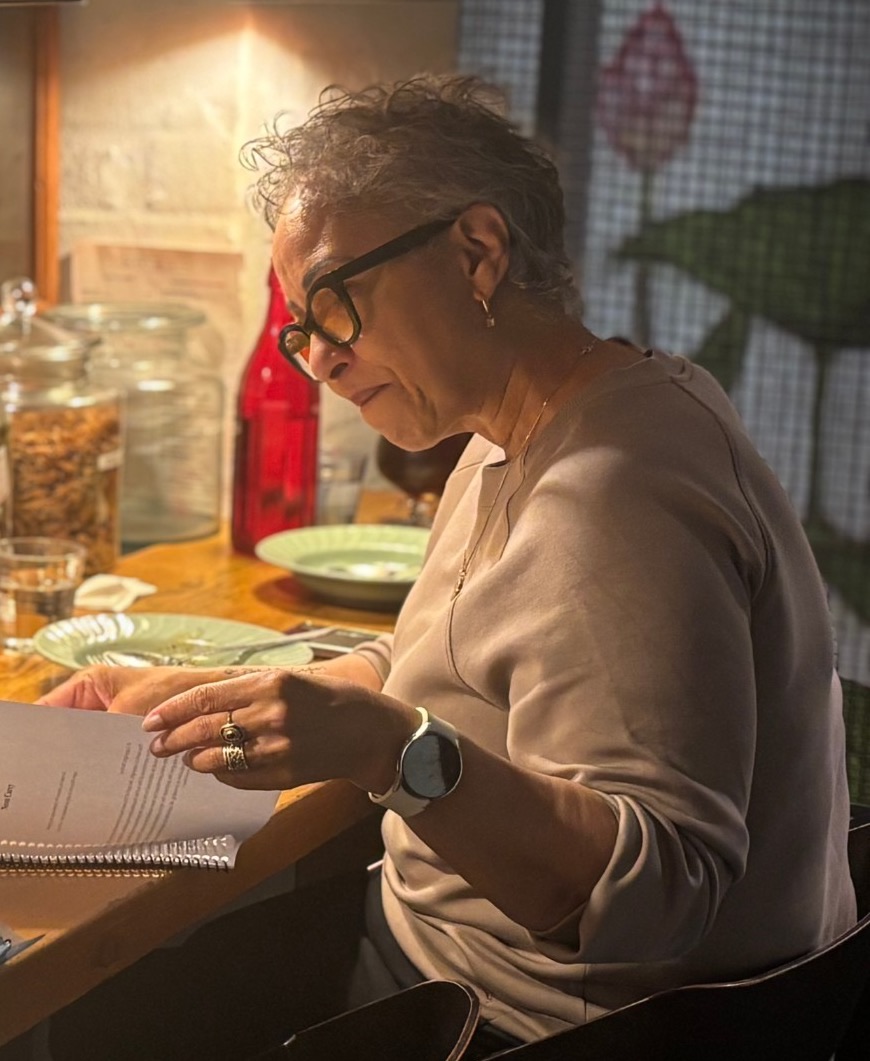
Nessa Carey is a playwright, English teacher and drama educator. Born into South Africa’s Coloured community under apartheid, she has lived in Australia for most of her life.
It began as a memoir — vignettes of incidents from her life, “most ordinary, some outstanding, and some people would say even unbelievable” — before she fictionalised those events into a stage drama centred on Aisha and her mother, Ma. Drawing on bell hooks’ idea of “talking back,” moving from silence into speech, Carey describes the writing as testimony rather than therapy.
“This wasn’t therapy for me. It was testimony. A public act that says: I was here, this happened, and I get to decide what it means.” Nessa Carey
The conversation three episodes, two recorded
Episode one UkuzwaNessa Carey in conversation with Teddy P on CWA — Collaboration With Artists, on writing a play about listening, and on what a title carries when it changes language.
Editorial note (30 July 2026)
This conversation was recorded before this page was published in June 2026. At two points it refers to Caged Light as a published book available from bookshops. That is not correct — the playscript is unpublished and has not been produced. The transcript and the audio are left unaltered as a record of the conversation. On 30 October 2026 music was added at the start and end, and the levels were evened out; the conversation itself is unchanged.
Hello, all you creative types out there — welcome to the CWA podcast, Collaboration With Artists, with your host, Teddy P. The podcast that interrogates works from budding writers with fresh stories to tell, who have recently become published. As we know, getting published is a big deal. Today we have a playwright who hails from South Africa but has lived in Australia for the majority of her life. Welcome, Nessa. It’s great to speak with you today about your play, Caged Light. The title alone is intriguing, so let’s start there.
Thank you so much for having me. It’s such a joy and a privilege to talk about this close-to-home project — close to my heart, close to my everything. The title is intriguing, but I’ll get to that a little later. First I need to set the scene, to give you some background so the play makes sense. Just imagine a dispossessed people, a group marginalised, who still maintain to some degree a continuing attachment to their land but aren’t able to engage with it. A people who had titles like princes and princesses — then everything was stripped away. The culture was vibrant and continuous, but stymied and oppressed by the politics of the country they called home, and yet abandoned by that same country: not white enough to be white, or black enough to be black. In between. Convenient and disposable. Forgotten, disenfranchised, on the periphery of everything. That is the story of Coloured people in South Africa under apartheid — and, unfortunately, beyond it too, living into the post-apartheid era. So that, in essence, is the backdrop — the historical and personal context that situates the play.
Of course — thank you. So why this title, and perhaps why at this stage of your life?
The title actually came later. I started writing almost as a memoir — vignettes about various incidents in my life: most ordinary, some outstanding, and some people would say even unbelievable. But while doing my Master’s in creative writing, I was inspired to try something different. I’m also an English teacher, keen on the performance side of stage drama — this idea of going from the page to the stage — so I was curious how my stories might become a living, breathing drama. So I thought, why not write a play? A challenging, daunting, overwhelming prospect, without a doubt. But I knew enough about stage drama to adapt my stories — to fictionalise them and build new characters around events from my actual life. The title only came to me after I’d written half the play. Here’s the irony in it: in my mind, a cage — reminiscent of the Doll’s House imagery, of Ibsen — a bird in a cage that can be released at any point, but doesn’t go. The light is a metaphor linked to the key character, Aisha. She is the beacon of light: she embraces the past and sets her sights on a new and impassioned future in Australia, where she takes charge of her academic career, her relationships, and her ultimate destiny. Her light had been caged in apartheid South Africa, and she carried that with her into her early life in Australia. That’s my reading of “Caged Light” — but it’s my hope, my dream, that people who see the play make their own meaning. They take the two words and ask, “What does this mean?” and interpret it as they will. Rather than me explaining, I think it’s prudent for people to watch the play, read the play, and interpret it for themselves.
Thank you for explaining. I think Edith Cowan University will appreciate your contribution to their academic literature — and it’s really helpful for our listeners to have that background. Can we move on to the writing process? You’ve confessed that your earlier drafts were a sprawling, episodic mess — six decades crammed into one script. What was the move that turned that pile of life events into a play?
Oh gosh — the humbling part is that it’s real. I actually teach drama; I teach the very stuff I was trying to recreate. The move was to stop covering and start patterning. Early on I tried to include everything, which gave me an episodic catalogue, not a drama. Then I noticed certain things kept recurring across my life: a charming man in both scenarios, a dangerous man in one, a car chase in both. Instead of treating those as separate incidents, I treated them as the same pattern repeating — because repetition exposes systemic violence in a way a tidy timeline never could. Patterns over chronology. And suddenly I discovered I wasn’t transcribing a life; I was building an argument with a shape.
Wow. It reminds me of how First Nations people talk about time as a circle rather than a straight line — that framework resonates deeply. You’ve also said that for a woman who has lived being categorised and silenced, writing this play is itself resistance — not just survival. What does it mean to you personally to pick up that pen and refuse to be silent?
That’s right. Silence is something we should move out of — as First Nations people are doing, becoming the voice now, articulating their sense of self. For my play, I referred to bell hooks, and what she called “talking back”: moving from silence into speech as a gesture of defiance that heals. For most of my life, the world told me who I was — it categorised me, contained me, decided what I was allowed to say. Writing this play is me taking that authority back. The final image is Aisha alone with her notebook, pen poised — because the pen is dangerous. It asserts the right to speak, to be heard, to shape your own story. This wasn’t therapy for me; it was testimony. A public act that says: I was here, this happened, and I get to decide what it means. There’s a profound freedom in that.
Gosh, I’m a bit lost for words — that’s quite vulnerable. Maybe moving on: you end the play with “I’ve always depended on the kindness of drafts.” I suspect that’s a direct riff on Blanche’s “kindness of strangers.” That’s either brilliant or, dare I say, audacious. Tell me you knew what you were doing.
Absolutely — it was deliberate. There’s an academic impulse to pretend we’re all original geniuses, but writers are essentially magpies: we steal, we borrow, we enhance, we play with what’s come before. The Blanche reference runs through the whole play — the opening, the middle, and the very last line, like a thread weaving throughout. It’s a cheeky note that says nothing is new under the sun; we’re all revising each other, and that’s okay. It’s not plagiarism — it’s literary DNA. Aisha, a teacher obsessed with Shakespeare and Williams, understands she’s using their language to understand her own life. So the final line is her reclaiming that language for herself. People go to the theatre, see the weaving of Tennessee Williams throughout, and it resonates with them.
That borrowing, which all writers do — myself included — leads to my next question, about revision: the going back in, in a more deliberate way. Ma, for instance, was barely there in your first draft, and then she became this guiding light. How did that transformation happen on the page, and what does it teach us about trusting the process of revision?
That’s a really good question. Process is important to me — any writer would say so. It happened through honest feedback and a willingness to dive back in. My course tutors pointed out that Ma was underdeveloped and could add another layer. In the first draft I’d paid only cursory attention to her, despite knowing she was instrumental in the way Aisha develops. So I returned to her and wrote a monologue that laid out her background and her motivation — for herself and for her daughter. In writing it, I discovered her: a woman wise beyond her limited education, who knew her daughter had to escape apartheid to realise her potential. She became the glue Aisha depends on for survival — in fact, the shining light in a bleak world. Ma taught me that revision isn’t just fixing mistakes; it’s discovery. Sometimes the most important character only reveals herself the second or third time through. Here’s an edited extract:
“I learned young that survival is a performance. You smile at the madam who pays you late. You nod at the man who calls you ‘girl’ when you’re forty-five. You save the rage for the kitchen, where only the pots can hear you scream. But that one — my Aisha — she’s different. She doesn’t swallow her words. She writes them down, files them like evidence. Sometimes I’m frightened by how much she sees. She looks at the street, this house, this life, and she doesn’t see shame — she sees stories worth telling. That’s dangerous. That’s necessary. When she was small, she’d ask me, ‘Ma, why do we live here?’ And I’d say, ‘Because this is where we landed.’ But what I meant was: because they drew the lines, and we weren’t allowed to cross them. Now she’s learning to draw the map — with words, with that dangerous pen of hers.”
That’s an example of Ma’s reflection on the Coloured people’s journey, and her intention to create space for Aisha to become what she could not. Ma is the conduit, the reason for Aisha’s escape. Placing her intimate moment with the audience near the beginning of the play became pivotal for engagement and for understanding both women. They become an interwoven essence of mother and daughter — doing this lovely dance, so in sync. That’s the power of the story between Ma and Aisha.
That’s powerful — thank you. I was fortunate enough to see some of those places in South Africa, the white spaces, the beachfront that’s been reclaimed. It’s a very moving and poetic allusion. Thanks for reading that part of Ma with such honesty — that can’t be easy. It seems the revisions worked in your favour, and Ma is a force to be reckoned with — a steady voice of reason amongst the chaos of the Wentworth backdrop, perhaps?
Absolutely. Ma is pivotal. Revising her character — and I’m so glad I did — was what was required for authenticity and legitimacy. That all happened in the revision. So revisions are paramount to a writer’s success, I think.
Thank you. Any final words about the play or the process — and when and where can we see it?
The best way is to get it at your local bookstore; I’m sure you’ll find the play there. As for the theatre, that’s in negotiation — we’re working on it. But honestly, if it comes close to you, please do me a favour and go and see it. It’s worth seeing — a slice of life within the South African apartheid era that’s really quite hidden and not often talked about. My play exposes all of that. So please, go and see it if you get the chance.
Thank you, Nessa — and thank you for drawing out that beautiful contradiction in such an authentic way. Everybody, thank you for tuning into the CWA podcast, where we promote new talent and expose you to things worth pursuing. Until next time — this is Teddy P, signing off.
Nessa Carey returns to talk with Teddy P about Umoya, her memory play set in a shared yard on the Cape Flats: why one isiZulu word holds air, wind, breath and spirit, how the play earns its grief through laughter, the magazine game, and Beatrice, the mother who reads tea leaves.
Hello, all you creative types out there, and welcome back to the CWA podcast — Collaboration With Artists — with me, your host, Teddy P. This is the podcast that sits down with writers who have fresh stories to tell. Last time, playwright Nessa Carey talked us through Ukuzwa. She’s back today with Umoya: eight children, two adults, one shared yard on the Cape Flats, and a mother who reads tea leaves. Welcome back, Nessa.
Oh, thank you, Teddy. It’s so good to be here, to talk about everything. I’m really, really excited to dive into Umoya. But can I just say, about Ukuzwa: remember, I changed the title, so people will know it as Caged Light. If you’re looking for Caged Light, it’s now called Ukuzwa. That was a deliberate decision, linking it to my South African heritage.
Yeah. Thank you. If it’s okay, we’re just going to go through some questions, like last time. Feel free to jump in, as I’m sure you won’t hesitate to do. So, the first question. Title first, as always: Umoya. Air, wind, breath, spirit. That’s a lot for one word to carry. Why this one?
Although Zulu, isiZulu, is not my first language, I thought it was really important to tap into that language, because in isiZulu one word carries so much weight. I think it works really nicely with the play, and that’s why Umoya. It means so much. It carries a lot; it’s weighty.
In this play, it’s Beatrice’s word, and it’s her world, and she actually says it in the play, because it’s all those things connected. For her — one of the main characters — when she can feel something coming, she says it’s in the air, it’s everywhere. She says umoya. And that yard was like that. The play happens in this contained space: houses on every side, facing one shared space. In this world, everybody knew everything. Gossip was in the air, and so was trouble, and so was love.
The wind is in it too. On the Cape Flats, you live in the wind. And then there’s breath and spirit. Who is still breathing at the end of the play is a question the audience is invited to answer, and then what survives of the people who aren’t — that sort of legacy, what continues after the play finishes.
I wanted a title that could hold the laughter — and that’s the key element, that correlation — the laughter and the grief in the same breath. If you see the play or read the play, you’ll get that sense of connection, even though they’re so opposite. Laughter and grief in the same space, in the same breath, is really an important image to hold on to when you read or watch the play.
In the same breath. Nicely done. Let’s talk about how you built it. This is a memory play. Older Lori stands at the edge of the light and tells us her story, and terrible things happen in it. Two deaths in the family. A pregnancy at seventeen. And yet your production notes say, and I’m quoting here, “This is not a tragedy dressed in sackcloth.” How did you strike that balance?
It’s a really difficult balance to strike, and I’m hoping that I achieved it in some way. Only audiences will be able to judge the success of that balance.
It’s about making the audience love the family first. I think it’s really important to construct this family as wholesome and loving and generous and kind and mad and chaotic. The notes say the play earns its grief by first earning laughter and affection, and I meant that as a rule for myself. If you meet the Richards children only in their worst moments, they become victims, and I didn’t want that, because in my imagination they are not victims. They are survivors, they’re drivers. They are so full of heart, energy, love and connection to each other. The last thing I wanted was for them to be constructed as victims.
So when you start, you meet Margie, the comedian. June is singing hymns at the wrong moments. Little Pete is always hungry. Lori’s doing Macbeth on the front step for her brothers and sisters. You laugh with them for a long time. Then, when Baby Ruth falls against that concrete step, the audience has lost someone too. The audience is so committed and connected to the characters that when Baby Ruth falls, it’s a loss for them, and they feel it. My hope is that they feel it quite viscerally, and they take a breath, even a deep breath, when that happens, because it’s unexpected.
Older Lori helps with the balance. She comes in and out as the play progresses. She’s in her sixties, and she’s wry, and she can say the hardest things with a dry little smile, because of her experience and her knowing. That’s how a lot of us carry these memories: with a joke held over the wound. It’s that tension between laughter and sadness. I’ve tried to communicate it from the beginning, but it becomes so much more pronounced as the play progresses.
Well, I hope that wasn’t a spoiler for people who haven’t seen the play. We won’t go into any more detail about what happens to that child. But there’s a scene I can’t stop thinking about. The children are alone at night with nothing to eat, and Lori picks up a discarded magazine and “feeds” them roast chicken and chocolate layer cake, all from a magazine. Where did that come from?
Imagination is crucial to the way this family connects, how they express their world and how they survive in it. So the magazine is a motif. And it does come from my own childhood: a story that was passed to me from my mother. It’s something I remember quite clearly — her talking about this magazine, and being so hungry, starving, not having anything to eat, and how imagination was a salve, actually. It acted as the thing that joined them together, and by doing this, they forgot their hunger.
So what I can tell you is why it’s in the play. Older Lori says it, in her words: “Hunger is a strange teacher. It teaches you to imagine. It teaches you to share what isn’t there.” That scene is the whole family in miniature. Nothing in the cupboard, absolutely nothing, and still a feast, because the eldest daughter refuses to let the little ones go to bed with nothing. She’s in charge. She tries to calm, she tries to appease, she does the things her mother wasn’t doing. And June says, in the play, “God doesn’t know it’s imaginary.”
The game comes back late in the play, after the second death, and this time Lori plays it alone and cries without a sound. That’s why this magazine game is so important. It holds everything together for this family. The same game, but it’s grief now, not play. Those magazine pages are the only moments of real abundance on the stage, beautifully articulated by Lori, but also expressed by the toing and froing and the banter of the children. I wanted the audience to feel how much of that abundance was made of imagination. Without that, there was nothing else. It was the only thing that kept them surviving, and kept them together. So it was really important to me to have the magazine game in the play, because it is based on reality.
That’s beautiful, and devastating. Let’s talk about the mother. Beatrice drinks. She uses charm as her currency. Older Lori says her mother never once told her she loved her, and yet the play never judges her. Last time, you told us writing is testimony, not therapy. Was it hard to be fair to Beatrice?
Yes and no. Beatrice is someone who existed. I’ve fictionalised a lot of it, but Beatrice is someone who existed, and she’s an important character in the play. And it is hard for me not to judge her, because she’s a mother to all these children, and yet she absents herself in so many ways from being that carer.
So for me, Beatrice was the most important thing to get right. She’s a mother, so she’s exhausted, she’s sharp-tongued, and she’s capable of sudden warmth — unexpected, mostly. There’s a moment when she touches Lori’s hand and then takes the warmth back, as if it costs her something she can’t afford. I understand that woman. She feels like she’s almost always teetering on the edge.
Look at what she’s carrying, and I hope audiences can see it and experience it and have some empathy: eight children, a husband who gambles away the rent, moving house again and again, and a system that has decided exactly how much her family is worth. When she reads the leaves and tells Lori she’s pregnant, she says, “Ja. I had plans too.” That’s a powerful, simply worded line, but I think that one line holds her whole life.
Older Lori says it plainly at the end: the system shrinks the world until the only people you can reach are the ones beside you, and so those are the ones you hurt. That’s human nature, I think, for the most part. And that’s where I wanted the anger to land, so that audiences connect with her humanity rather than judging her as a mother.
Last time, we also talked about you borrowing from Tennessee Williams. This time it’s Shakespeare. Lori performs Macbeth on the step, and the last section of the play is called “Fair is Foul”. And there’s a mother who reads the future in a teacup. Tell me you knew what you were doing. It’s quite an interesting contradiction.
Well, yes. I’m an English teacher, so when I’m writing anything, I try to find threads or connections to things I’ve read before. There’s really nothing new under the sun, but I’m trying to adapt or tweak or recreate, and as an English teacher I’m doing that all the time. I can’t help myself, essentially.
But it’s not decoration. Lori is a bookish girl going barefoot to school, and Shakespeare is hers, something nobody can take from her. I think that’s really essential to understanding Lori as the young, clever character that she is.
And here’s the correlation: the witches tell Macbeth his future, and Beatrice tells everyone’s future in the leaves. Older Lori says her mother could read everyone’s future except her own. And “fair is foul, and foul is fair” starts as a lesson Lori gives her siblings and ends as the truth of the whole play, which I think is really important to understand. A kindness can be a threat. A pot of fish curry, which we know is a pivotal moment in the play, can be a peace offering or something much darker, and you may never know which. Even Ravi wins her over by talking about Macbeth.
It’s the same magpie habit I talked about last time. We borrow the old language to understand our own lives. I think most writers would agree that the borrowing is really important. It could be deliberate, or almost incidental, or even accidental, but writers do it, and if you know those connections, it makes the play, or whatever work you create, a richer experience. I was trying to do that in this play as well.
Yeah. Which brings us towards the end of our chat. The play closes on a teacup in a narrowing light, and the children back in their places from the opening. Older Lori’s last words are, “Hamba kahle, Ma. Go well.” What do you hope people take home?
Oh, gosh. It’s an interesting line, and I think it’s important that it’s said in isiZulu, linking back to that language. That line is a goodbye and a blessing at the same time. She hopes, wherever her mother is, there’s tea, and a cigarette, and nobody asking her to read their future. It’s forgiveness, really, with a little smile in it.
Then the hymn the children sang at both deaths, “Abide with Me”, turns into township jive. Grief becoming defiance. That’s what I hope people leave with. These were real, funny, loving families, living in a yard that the system built to contain them, and they kept singing anyway. And I think that’s the nature of Coloured — in inverted commas — Coloured people. That resilience is, without question, what makes them a thriving, strong group of people, a force to be reckoned with, if you will, in the complex world of apartheid South Africa. So I think that’s really important.
Yeah, yeah. Where can people find Umoya?
Oh, gosh, it’s interesting, because I’m still in the process of trying to get it all sorted, and hopefully published. But at the minute, it’s on the Ukudala page on the Ridgeline Advisory site, where you can access it with my other plays. It’s also in Ukudala, the collection of all five of the plays I’ve written to this point. It hasn’t been staged yet, so I’d love to hear from theatre makers who want to bring that yard, and the people, and the interesting and funny and sad characters to life. I’m so, so chuffed about this play, and I really think it needs to be seen. So let’s hope. Let’s cross fingers.
Well, Nessa Carey, thank you. And thank you, everyone, for tuning in to the CWA podcast, where we promote new talent and share things we’ve discovered that are worth pursuing. Until next time, this is Teddy P signing off.